Quick answer
Inflation drives up insurance costs by increasing both how often claims occur and how much they cost, so insurers raise rates to avoid underwriting losses. Personal auto premiums grew 14.3 percent in 2023, the highest in over 15 years, and auto liability claim severity rose more than 70 percent from 2014 to 2023.
This article explains how inflation increases consumer insurance costs by raising the frequency and severity of claims, which forces insurers to raise premiums to cover higher losses. It highlights that both commercial and personal auto insurance have experienced underwriting losses due to inflation-driven cost increases, with personal auto insurance premiums growing significantly in recent years. The article also quantifies the impact of economic and social inflation on auto liability losses and defense costs through recent research findings.
Key Takeaways:
Insurance is priced to reflect the underlying risk of every policy. When more claims are filed and the average amount paid of those claims increases, insurance becomes more expensive. A measure of underwriting profitability for insurance carriers is the combined ratio calculated as losses and expense divided by earned premium plus operating expenses divided by written premium. A combined ratio over 100 represents an underwriting loss. When expected losses increase, an insurance carrier must increase premiums by raising rates to maintain a combined ratio under 100.
Commercial auto insurance has recorded a net combined ratio over 100 nine times out of 10 between 2014 and 2023, and, according to the latest forecasting report by Triple-I and Milliman, continues to worsen in 2024. According to the Triple-I Issues Brief, personal auto insurance has had a net combined ratio over 100 for the past three years, with a 2023 net written premium (NWP) growth of 14.3 percent, which was the highest in over 15 years.
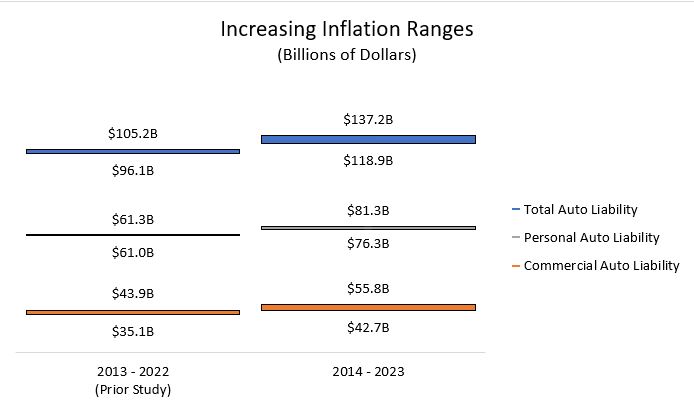
From 2014 through 2023 economic and social inflation added $118.9 billion to $137.2 billion in auto liability losses and defense and cost containment (DCC) expenses. This represents 9.9 percent to 11.5 percent of the $1.2 trillion in net losses and DCC for the period and an increase of 24 percent to 31 percent from the previous analysis on years 2013 through 2022.
A new study – “Increasing Inflation on Auto Liability Insurance – Impact as of Year-end 2023” – is the fourth installment of research on the impact of economic and social inflation on insurer costs and claim payouts. Compared to the prior study, Commercial Auto Liability loss and DCC is 20.7 percent to 27.0 percent ($43 billion to $56 billion) higher due to increasing inflation. Personal auto liability loss and DCC is 7.7 percent to 8.2 percent ($76 billion to $81 billion) higher from increasing inflation.
Key Takeaways
Insurance is priced to reflect underlying risk. When more claims are filed and the average amount paid per claim rises, insurance becomes more expensive. Insurers must raise rates when expected losses increase so they can keep their combined ratio under 100 and avoid an underwriting loss.
A combined ratio is a measure of underwriting profitability, calculated from losses and expenses relative to premium. A combined ratio over 100 represents an underwriting loss. When expected losses rise, a carrier must raise rates to maintain a ratio under 100.
Personal auto net written premium growth was 14.3 percent in 2023, the highest in over 15 years. Personal auto has had a net combined ratio over 100 for the past three years, driven by inflation-related loss increases.
Economic and social inflation together added between $118.9 billion and $137.2 billion to auto liability losses and defense and cost containment expenses from 2014 through 2023. That is 9.9 to 11.5 percent of net losses and expenses for the period.
Severity of auto liability claims continues to increase year over year and rose more than 70 percent from 2014 to 2023 for both commercial and personal lines. Frequency of claims in 2023 was unchanged for commercial auto liability and lower for personal auto liability compared to 2020.